Publisher's View
Living in Pittsburgh as a Black Mom & Entrepreneur
As PUM Forward launches, our publisher reflects on her 30-year journey from the WPXI-TV newsroom to sustainable entrepreneurship—grounding her personal story within the stark data of local systemic disparities.
When I first moved to Pittsburgh in 1993 to work for WPXI-TV, I arrived with the same cautious optimism shared by many media professionals of my generation. I was stepping into a historic city actively trying to reshape its post-industrial identity. Over the next three decades, as I moved out of the newsroom and navigated the rigid corridors of corporate Pittsburgh, I experienced the deep, often frustrating contradictions that define this region for African Americans.
The truth is, when it comes to living in Pittsburgh, the statistics don't lie. I have watched many of my talented Black peers get left out of traditional advancement loops until, tired of waiting for closed tables to turn, they packed up and left the region entirely. Their exodus is backed by hard, documented data: a landmark study by the city's Gender Equity Commission revealed that Black residents in Pittsburgh face lower household income, steeper school-to-prison pipelines, and worse health outcomes than Black residents in nearly 90 percent of similar American cities. Furthermore, corporate workforce rankings have historically placed Pittsburgh dead last for Black professional mobility and executive retention. In Pittsburgh, the survival mechanism has long been a quiet, exhausting mandate: you get in where you fit in.
Yet, on the other hand, there is a parallel truth to my journey. This city has also been profoundly good to me. It provided a stable, scalable foundation where I could buy a home, enroll my children in excellent schools, and ultimately launch a sustainable, independent business in 2009—milestones that would be nearly impossible for an independent builder to achieve in hyper-expensive coastal markets like Seattle today. Talking to friends and family back in Seattle, I frequently wonder: would I have been able to achieve everything I have here if I had stayed there? The answer is likely no.
Looking back, the journey was entirely worth it. Every lesson learned through the friction of this city has served a purpose. Like the steel that defines this region, Pittsburgh has made me bendable, resilient, and deeply proud to be a Pittsburgher.
But my success cannot exist in a vacuum. I want other African Americans to succeed here, to find their footing, and to bypass the invisible corporate ceilings that have held so many back. Through the launch of PUM Forward, I am hoping to build the exact digital infrastructure, storytelling platform, and capital visibility required to make that success a reality for the next generation. This is Our city, Our history, and Our forward path.
— By Robin Beckham Publisher of Pittsburgh Urban Media

Rebuilding Our Village
Pittsburgh's Youth: Hope or Harm?
A man beaten unconscious in East Liberty.
A woman attacked by teenagers days earlier.
Masked groups intimidating concertgoers downtown.
Fireworks exploding in crowds. Viral fights in stores. Teens gathering in large groups while adults watch from a distance — uncertain whether to intervene, afraid of what could happen if they do.
Across Pittsburgh and cities throughout America, many parents are asking the same question:
What is going on with our youth?
The easy response is to call these incidents “isolated.” The dangerous response is to paint an entire generation — especially Black teenagers — as violent or hopeless. Neither tells the full story.
Most young people are not harming anyone. Most are navigating school, friendships, anxiety, family struggles, jobs, and a nonstop digital world while trying to figure out who they are. Many teens in Pittsburgh are doing extraordinary things every day: mentoring younger children, working summer jobs, creating music and art, volunteering in neighborhoods, and preparing for college and careers.
But there is also a visible rise in public disorder and aggression that communities can no longer pretend not to see.
Parents see it.
Business owners see it.
Teachers see it.
And teenagers themselves see it.
The deeper issue may not simply be violence. It may be the erosion of the “village” that once helped shape boundaries, accountability, and belonging.
Years ago, neighborhoods often operated with shared expectations. Elders corrected children. Coaches mentored beyond the field. Churches, recreation centers, corner stores, and families worked together — imperfectly, but collectively — to guide young people. There were consequences not only from parents, but from community itself.
Today, many adults hesitate to speak to teenagers in public at all.
Some fear escalation. Some fear retaliation. Some fear being recorded on social media. Others fear accusations of targeting young Black youth unfairly. The result is a strange and growing silence where adults see troubling behavior but feel powerless to address it.
Young people notice that silence.
At the same time, today’s teenagers are growing up in an environment unlike any previous generation. Violence is streamed in real time. Conflict becomes content. Humiliation becomes entertainment. Social media rewards outrage, intimidation, and spectacle with views, likes, and status. A teenager wearing a ski mask in the middle of summer is no longer just hiding from the cold — sometimes it is about identity, anonymity, image, or intimidation.
The masks have become symbolic of something larger: disconnection.
Not every teen wearing a mask is dangerous. But communities are increasingly asking whether anonymity is emboldening reckless behavior in public spaces. Businesses and downtown districts are quietly debating what safety, accountability, and public order should look like moving forward.
Still, focusing only on punishment misses the larger crisis.
Teen behavior does not exist in isolation from the emotional condition of the country around them.
Young people are absorbing:
- political division,
- economic instability,
- constant online hostility,
- images of war and violence,
- fractured families,
- loneliness,
- and a culture where attention often matters more than empathy.
Children mirror the world adults create.
But compassion without accountability also fails communities.
Too often, difficult conversations stop the moment responsibility is mentioned. Parents who actively monitor their children, track their whereabouts, know their friends, enforce curfews, and stay involved are sometimes dismissed as “doing too much.” In reality, many dedicated parents feel they must work overtime simply to protect their children from influences coming from phones, peers, algorithms, and the streets.
Communities cannot continue pretending that accountability is optional.
That accountability belongs everywhere:
- parents,
- schools,
- courts,
- social media platforms,
- community leaders,
- and the broader culture itself.
At the same time, Pittsburgh is filled with organizations doing extraordinary work to reach young people before violence does. Grassroots mentoring groups, youth empowerment programs, churches, coaches, arts initiatives, and community organizations continue showing up every day. The city is not lacking people who care.
What may be lacking is scale, consistency, and a renewed willingness for communities to speak honestly.
Opportunity matters. Recreation matters. Jobs matter. Mentorship matters.
But so do boundaries.
So do consequences.
So does the courage for adults to say: this behavior is unacceptable, and we will not normalize it.
The question facing Pittsburgh is not whether all teenagers are out of control. They are not.
The real question is whether adults still believe it takes a village to raise children — and whether that village is willing to find its voice again before fear, silence, and division become the loudest influences shaping the next generation.
ROBIN BECKHAM
May 29, 2026
Founder & Editor
PittsburghUrbanMedia.com

From the Editor: The Pulse of the Community
Hope and Action in Pittsburgh
Last night, I was listening to Georgia Senator Raphael Warnock on MS-NOW, and his words on voting rights and hope were incredibly impactful—especially during times when our communities feel under attack.
He shared something powerful: hope is not just optimism. Hope is “a shot at working with God to write a new chapter for human possibility.”
That message hit deeply.
Following the 2026 Supreme Court ruling limiting protections under the Voting Rights Act, Senator Warnock called it a “profound defeat for American democracy.” He spoke passionately about how these decisions allow partisan politicians to pick their voters instead of voters choosing their leaders.
But even in that disappointment, he pointed us back to action.
He stressed that if the Court will not protect voting rights, then Congress must act by passing federal legislation like the John R. Lewis Voting Rights Advancement Act to restore those protections and fight voter suppression.
One of the most powerful reminders he gave:
“Voting rights are preservative of all other rights.”
And even more:
“A vote is like a prayer for the community.”
That is the truth.
We cannot be silent. We cannot be discouraged. We must stay engaged, informed, and committed to protecting the power of our vote.
Hope is action.
Hope is faith.
Hope is participation.
I am inspired by Senator Warnock, he is not afraid to TELL it like it is and he has the wisdom, and the backbone to say it loud and say it proud.
ROBIN BECKHAM
April 30, 2026
Founder & Editor
PittsburghUrbanMedia.com

Georgia Senator Raphael Warnock
Tracking the Draft Funds
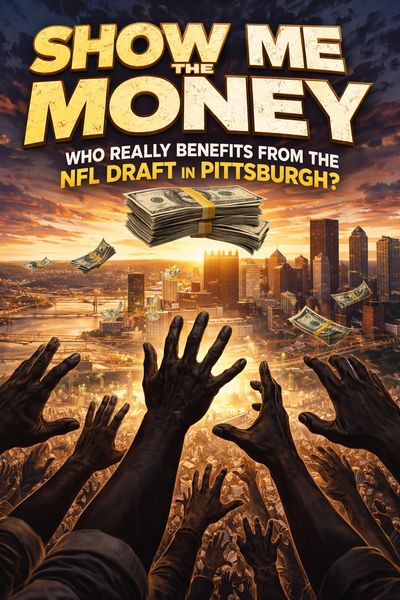
Who Benefits from Pittsburgh's NFL Draft?
“Keep your mind on your money, and your money on your mind.” — Snoop Dogg
As the NFL Draft prepares to take over Pittsburgh, the headlines are filled with excitement, projections, and promises of economic growth.
We’re being told this is a transformational moment for the region.
But beneath the surface of the fanfare and forecasts lies a deeper, more important question:
SHOW ME THE MONEY.
Public Dollars, Private Decisions
Let’s start with what we know.
At least $18.9 million in public funding is being directed toward the NFL Draft. That includes a $10 million grant from the state, awarded through the Department of Community and Economic Development’s Marketing to Attract Marquis Events program.
Those funds were given to VisitPittsburgh—a publicly funded nonprofit tasked with marketing and coordinating the event.
The expectation?
That this investment will generate between $120 million and $213 million in economic impact, with projections of 500,000 to 700,000 attendees coming into the city.
Sounds like a win for everyone.
But is it?
The Illusion of “Economic Impact”
“Economic impact” is one of the most powerful phrases used in large-scale events.
It sounds definitive. Measurable. Promising.
But in reality, it’s a projection—often built on models, assumptions, and best-case scenarios before the event even takes place.
How do we determine attendance before the crowds arrive?
How do we guarantee spending that hasn’t happened yet?
And more importantly:
How does that “impact” actually reach the people who live here?
Because “impact” doesn’t automatically mean equity.
Follow the Money
According to public information, VisitPittsburgh has broad discretion on how these funds are spent.
That includes:
- Marketing campaigns
- Vendor contracts
- Staffing and operational costs
- Payments to contractors helping execute the event
In other words:
Decisions are being made about who gets access to millions of dollars in opportunity.
And those decisions matter.
Because access determines outcomes.
Let’s Set the Record Straight
There has been a narrative circulating—subtle but persistent—that Black businesses and professionals were somehow unprepared for this moment.
That narrative is not only misleading—it’s false.
Many Black entrepreneurs:
- Followed the rules
- Applied through the official processes
- Positioned themselves for participation
They did exactly what they were told to do.
And still, many are watching from the outside.
Access vs. Optics
This is not about a lack of effort.
This is about access.
Because what continues to play out is a familiar pattern:
- “Who you know” relationships driving decisions
- Pre-established vendor networks being prioritized
- A handful of smaller deals distributed as proof of inclusion
Meanwhile, larger, more lucrative contracts often land in the hands of the same companies that have always had access.
Let’s be honest:
A few small wins do not equal equitable participation.
They create optics—not ownership.
Designed Outcomes
At the end of the day, we have to confront an uncomfortable truth:
Outcomes like this are rarely accidental.
They are often designed.
Designed through networks.
Designed through relationships.
Designed through systems that reward proximity to power.
So when we hear the phrase:
“It’s not what you know, it’s who you know”—
We have to recognize that it’s more than a saying.
It’s a system of access.
A system that determines:
- Who gets the call
- Who gets in the room
- Who gets the contracts
- And ultimately… who gets paid
Who Really Benefits?
With so many public resources attached to this event, residents are asking the right questions:
- How much economic impact will actually be realized?
- Who will see that impact firsthand?
- And how will it be reinvested into the communities that need it most?
Because if public dollars are funding this moment, then the benefits should be publicly shared.
Not concentrated.
Not filtered.
Not limited to those already inside the circle.
After the Applause
The stage will be built.
The crowds will come.
The cameras will roll.
And for a moment, Pittsburgh will be the center of the football world.
But when it’s over—when the lights go down and the visitors leave—what will remain?
Will there be lasting opportunity?
Sustainable growth?
Real reinvestment?
Or will this be another moment where:
Public money created private gain—just not for everyone.
Final Word
At the end of the day, the question is simple:
WHO BENEFITS?
Because too often, we find ourselves:
- Last to gain
- First to be questioned
- And expected to be satisfied with scraps instead of shares
Let’s be clear:
Black businesses were ready.
Black professionals showed up.
But the opportunity was filtered.
And until that changes—until access is expanded, transparency is demanded, and equity is intentional—
We will continue to say, louder each time:
SHOW. US. THE. MONEY.
Robin Beckham
Founder & Editor
PittsburghUrbanMedia.com
Author: Memoirs of Missy
April 7, 2026
Article from Public Source with more financial details:
https://www.publicsource.org/nfl-draft-spending-public-investments/
Strategic Assault on Humanity
Strategic Racial Dehumanization
When Strategy Meets Dehumanization: Why That Video Was Not an Accident
By Robin Beckham, Editor & Founder, Pittsburgh Urban Media
This morning, I debated whether I was going to share a despicable image with my beautiful Black daughter. As she stood ready for the day—dressed, on time, backpack secured, with hope and promise shining in her eyes—I felt a familiar, sinking pain as a mother. The pain of knowing that once again, I would have to explain something no child should have to carry. The kind of conversation Black parents have far too often. The kind that happens in Black homes when innocence collides with reality.
The image in question—a video released by the President depicting Barack Obama and other Black figures as apes—was not just offensive. It was dangerous. It was dehumanizing. And it was deeply rooted in a long, ugly history that Black people know all too well.
As a PR professional, I understand exactly how and why that video was released, including the intent behind its timing and dissemination. This was not accidental. It was calculated and strategic, not incidental. The rollout followed a familiar and troubling playbook: provoke outrage, dominate the news cycle, and force reaction before reflection can occur. It was engineered for virality, amplified through channels that reward shock, and designed to spread quickly in a digital ecosystem where attention—any attention—is currency.
This is how narratives are manipulated. This is how harm is normalized.
Let’s be clear: portraying Black people as apes is not “humor,” nor is it political commentary. It is one of the oldest tools of racial dehumanization, historically used to justify violence, exclusion, and the denial of basic humanity. When that imagery is resurrected—especially by someone in the highest office in the country—it is not just a dog whistle. It is a declaration of disregard.
And while pundits debate intent, Black parents are left doing damage control at kitchen tables and front doors before school. We are left explaining why someone with power would choose to circulate an image that tells our children, implicitly or explicitly, that they are less than. We are left affirming dignity in a world that too often tries to strip it away.
This is why strategy matters. This is why accountability matters. When harmful content is released deliberately, it is not enough to dismiss it as provocation or political theater. We must name it for what it is: a calculated effort to push boundaries, desensitize the public, and see how much harm can be inflicted without consequence.
In Black homes, we don’t have the luxury of abstraction. These moments are personal. They live in the questions our children ask, in the pauses we take before answering, and in the resilience we are forced to summon yet again.
My daughter deserves a world where her humanity is not up for debate or clicks. And until that world exists, we will continue to tell the truth—about history, about strategy, and about the real-life impact of images that are never just images.
Not when they are intentional. Not when they are strategic. And certainly not when they come at the expense of our children.

Pittsburgh's Urban Voice
Facing Authoritarianism in Pittsburgh
OP-ED January 9, 2026
BY: Wisdom O. Cole is the Senior National Director of Advocacy for the NAACP.
As the dawn of a new year emerged - a time of hope, optimism, and excitement for what's to come - Keith Porter, 43, was fatally shot by an off duty U.S. Immigration and Customs Enforcement (ICE) officer in Los Angeles, CA. Not long after, on January 7 in Minneapolis, MN, 37-year-old Renee Nicole Good was shot in her car and killed by an ICE officer. These acts of domestic terrorism not only took two parents from their families, but are a threat to everyone's safety. No community in America should be subjected to violence as a result of federal enforcement actions.
AUTHORITARIANISM IS ON THE RISE
As we reach the 1 year mark of the second Trump Administration, I see the rise in our collective anxiety, fear, and frustration with the state of our increasingly authoritarian nation. The Trump Administration's tenure has prioritized public fear under the guise of public safety by protecting these officers' crimes against the public. As we see the highest office in the nation forgo the rule of law, I ask the question of myself and of us: what are we to do when authoritarianism comes for you?
Last year, Donald Trump started his new tenure with an attack on immigrants through ICE raids across the country. These raids created a divisive narrative among communities of color, posing questions of whose problem this was, who was at fault for putting Trump back into office, and who is responsible for addressing the issue. This narrative that the ICE raids were not a Black issue was very difficult for me to digest. As someone whose identity is constantly bound between two worlds that often seem at war with one another, I know that the answers are not that simple. Throughout history we've seen that when they come for one of us they are planning to come for all of us. It's never a matter of if but when. That reality is playing out in real time as the Administration has cracked down on crime in cities across America led by Black elected leaders. I feel the ever present police state grows as our democratic institutions falter. In these dire times, how do communities resist and survive?
LESSONS FROM THE BLACK PANTHER PARTY
I often consider myself a third generation Black Panther Party (BPP) member, a part of what I would consider the legacy and revival movement. I attended University of California Santa Cruz during my undergraduate years, the same place where BPP co-founder Huey P. Newton got his PhD in the History of Consciousness. I participated in a state wide coalition called the Afrikan Black Coalition (ABC), which was inspired by and a part of the continuum of Black radical tradition of BPP survival programs pending revolution. Last summer forBlack August I reread the autobiographies of Panther leaders and realized the Party did present a framework for the fighting authoritarianism in our communities. The BPP's framework shows that when authoritarianism comes for you, we must analyze power, build survival infrastructures, and shape liberatory narratives.
Power is the ability to define phenomena and make it act in a desired manner. - Huey P. Newton
What we are experiencing in America - and frankly across the globe - is not by accident, it is rooted in capitalism, state sanctioned violence, and the abuse of power. The leaders of the BPP knew how important it was to analyze and name authoritarianism as structural and not just personal. More and more often I feel a sense of racial paranoia, asking myself if these things I am experiencing are really happening or if it's just my life. It is easy to disregard and disengage seeing the violence happening in our world. The normalization of overwhelming the public with bad public policy, increased state violence, and a lack of hope through these very difficult times is all purposefully to keep our minds in submission. But these are not just individual instances happening to random groups of people. IThey are deliberate and calculated attacks on those most marginalized in our communities. The Panthers knew that freedom began when communities defined a future for themselves outside of authoritarian control. We cannot just fight the symptoms, we have to identify and challenge the structure that continues to fuel this monster that seeks to destroy all of us.
We have survival programs to survive today, to survive tomorrows, until we get full control of our destiny. - Elaine Brown
Last Black August I took the practice of study, fast, train, fight quite literally. When the Trump Administration took back the executive office, my mind was not ready. The bombardment of an aggressive roll back of our rights and attack on our communities crippled my mind and damn near my body. It got to the point where I struggled breathing and could barely pick things off the ground. The Panthers knew how important it was to prepare their mind, body, soul, and spirit for what was to come pending revolution. They knew that it would not come lightly or just given to them, they had to prepare themselves and the community through survival and resistance programs. If the government was not going to feed our children, they did it themselves. In this time, I have been thinking a lot about how mutual aid will have to fill in the gap for many who the state has abandoned to meet their day to day needs. But this is what authoritarianism does, it isolates and eliminates. We have to counter through community care systems, food banks, community defense networks, mental health supports, political education, and safe spaces to provide resources.
Revolution is about the need to re-evolve political, economic, and social justice, and people are not going to be free until they have some sense of power. - Bobby Seale
Lately, I have been in many discussions about messaging and language. Much of the language used in politics is intentionally chosen to keep many from understanding what is truly going on. How can you fight back when you don't even understand what's going on, who the real enemy is, and what tools are available to support your community to fight back? Many of the things that we once had are being eliminated in the blink of an eye or preemptively being rolled back out of fear for loss and I can't even understand the words that are coming out of the mouth of my chosen advocate or elected president, especially one who spews misinformation as absolute truth. The Panthers understood that language is power and by keeping things direct, accessible, and unfiltered, people could connect to a sense of power. They recognized the use of art, writing, and speeches can make you want to get up on your feet and reach for the heavens because you felt something that touched the core of who you are - and married it to the core of who we ever desired to be. We must shape our narrative and our lived reality. Authoritarianism thrives on fear and disinformation, we have to counter it with truth, clarity, and hope.
COMMUNITY, COURAGE, AND VISION
When I was in college, a good friend of mine asked me if I was around in the 60s, did I think I would have been a part of the Black Panther Party. I said no. I don't think I had the knowledge of self, the experience to fight, and wherewithal to endure all I knew the Panthers went through. That friend shared a quote with me from Huey P. Newton: "The revolution has always been in the hands of the young…the young always inherit the revolution." I have held that quote dear to my heart for the last decade of my organizing career. As we are being pushed back into a 1960s reality I am reminded that even in the face of oppression, communities can survive, resist, and reimagine freedom. Authoritarianism is not inevitable. But we must act collectively, courageously, and with vision to survive.
Source: NAACP