
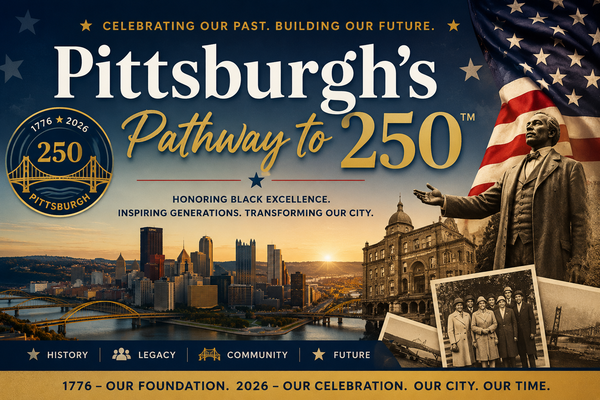


A Definitive, Year-Long Campaign
As America approaches its historic Semiquincentennial, PittsburghUrbanMedia is launching a definitive, year-long campaign. We are permanently centering Black history, resilience, and triumph at the heart of Western Pennsylvania's identity. From the underground freedom lines of 1780 to the neighborhood builders, medical innovators, and cultural pioneers of today — this franchise will reclaim our central place in the narrative of this Commonwealth.
Step into an unbroken, 250-year narrative of African American resilience, leadership, and triumph that permanently shaped Western Pennsylvania. Explore our pillars of impact, uncover the deep history of your neighborhood, and see how the bedrock of Pittsburgh's excellence continues to inspire the next 250 years of progress.
Black Pioneers of Western PA
The Frontier Era, 1750s–1800
Long before the Declaration of Independence was signed in Philadelphia, and decades before Pittsburgh was incorporated as a city, free and enslaved African Americans were charting a pathway of survival, labor, and fierce resistance along the dangerous Western Pennsylvania frontier.
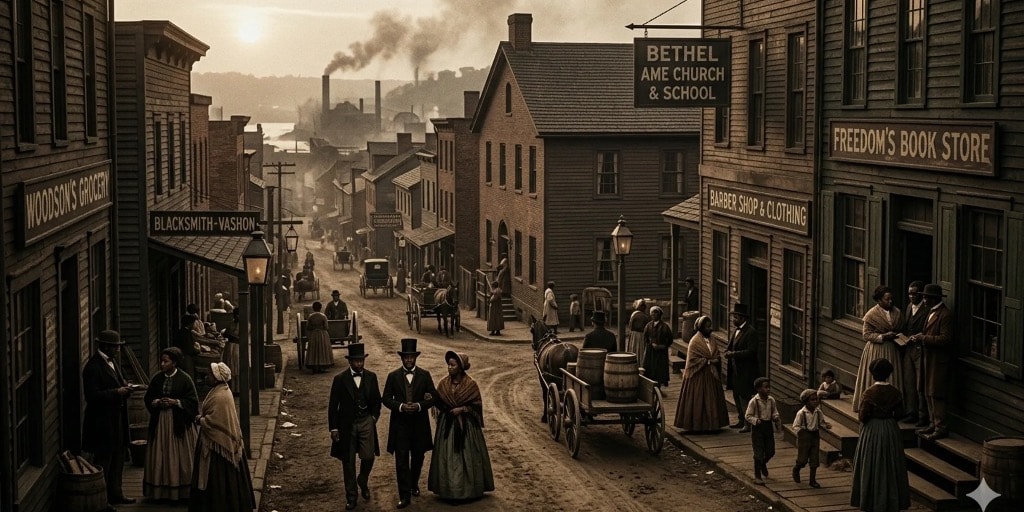
To find the true starting point of Black history in Western Pennsylvania, we have to look past the cobblestones of the 19th-century Hill District and go deep into the untamed wilderness of the mid-1700s. In the 1750s, the Forks of the Ohio — where the Monongahela and Allegheny rivers meet to form the Ohio River — was the most hotly contested real estate on the continent. As French and British empires fought for control of the region, African Americans were present, functioning as skilled laborers, military teamsters, linguists, and frontier scouts.
The earliest documented Black individuals in the region arrived during the French and Indian War. When British Major General Edward Braddock marched his army toward the French-held Fort Duquesne in 1755, his ranks included Black teamsters and laborers. Among them was Samuel Jenkins, a Black man who drove a provision wagon through the treacherous Allegheny Mountains — among the first to clear the very roads that would later become the commercial arteries of Western Pennsylvania.
The turning point came on March 1, 1780, when the Pennsylvania legislature passed the Gradual Abolition Act — the first law of its kind in the democratic world. Enslaved people in early Pittsburgh actively weaponized this new law. They took to the local courts, suing their masters for freedom, tracking their birth dates meticulously, and establishing early autonomous communities. These frontier resistance fighters laid the structural bedrock for the sophisticated Underground Railroad networks that would later define the city.
Black excellence in Pittsburgh did not begin in the modern era; it was forged in the fire of the early American frontier.
Black teamsters, including Samuel Jenkins, navigate the Western PA wilderness during General Braddock's historic campaign near the Forks of the Ohio.
Early Fort Pitt garrison returns and civilian ledger entries record the presence of free and enslaved African Americans working as camp laborers, blacksmiths, and traders.
Pennsylvania passes the Gradual Abolition Act, transforming Southwestern PA into a critical legal and physical battleground for Black self-liberation.
Allegheny County is officially formed. Early tax assessments register free Black landowners establishing roots and small businesses in the fledgling borough of Pittsburgh.
The Legacy: The early Black pioneers of the mid-18th century proved that African Americans were not late additions to the story of Western Pennsylvania — they were foundational builders of the region. By clearing the forests, building the fortifications, and launching the very first legal and physical rebellions against slavery, these early hidden figures set the trajectory for Pittsburgh's 250-year arc of Black agency, resilience, and triumph.
This profile is part of Pittsburgh's Pathway to 250™: Black Excellence & Legacy, a multi-platform initiative by PittsburghUrbanMedia.
Hidden Routes of Freedom in PA
The Underground Railroad Network
Long before the civil rights movements of the 20th century, a highly organized, dangerous, and deeply courageous network ran through the valleys, hills, and rivers of Pennsylvania. Due to its position right along the Mason-Dixon Line, Pennsylvania was the gateway to true freedom. Enslaved individuals risked everything to cross its borders, relying on a hidden alliance of Black entrepreneurs, brave families, and radical abolitionists.
The Bigham House
Mt. Washington, Pittsburgh
Perched high on the cliffs overlooking the Monongahela River, this estate of abolitionist lawyer Thomas James Bigham served as a critical lookout point. Safehouse conductors used the high altitude to watch for incoming danger or approaching bounty hunters, safely hiding travelers before helping them move northward under the cover of darkness.
The City Baths & Vashon Barbershop
Downtown Pittsburgh
Run by prominent free Black abolitionists John Vashon and his son George, this downtown public bathhouse and barbershop doubled as a highly strategic urban safe house. Because people from all walks of life constantly moved in and out of the building, freedom seekers could seamlessly blend into the crowd, receive fresh clothing, and wait safely for their next guide.
The LeMoyne House
Washington, PA
Built by Dr. Francis Julius LeMoyne, this historic stone manor stands as Pennsylvania's very first National Historic Landmark of the Underground Railroad west of the Allegheny Mountains, preserving the physical spaces where history was made.
Blairsville Underground Railroad History Center
Blairsville, PA
The town of Blairsville hosted an incredibly fierce and protective network of 93 documented local conductors. In one legendary account, the townspeople successfully formed a human shield to prevent a southern slave catcher from taking a resident back across the border.
The Allegheny Portage Railroad
Gallitzin, PA
To cross the steep, formidable Allegheny Mountains, freedom seekers cleverly utilized the state's complex system of canals, incline planes, and cargo rail boxcars — secreting themselves among commercial freight or using the rail paths as a physical map through the dark mountain passes.
Freedom Road Cemetery
Mercer, PA
In Mercer County, a community of free Black citizens and escapees established a permanent, safe settlement. They built homes, farmed the land, and fiercely defended one another from bounty hunters. The historic cemetery remains today as a quiet, powerful monument to those who chose to stay and build a future on Pennsylvania soil.

Arthursville: Pittsburgh's Black Fortress
Lower Hill District, 1830s–1890s
Decades before the Civil War, a vibrant, self-sustaining community of free Black landowners, entrepreneurs, and activists thrived in a lost neighborhood in Pittsburgh's Lower Hill District. They called it Arthursville.
By the early 1830s, Pittsburgh was rapidly transforming into the industrial, coal-fueled "Smoky City." A remarkable enclave began to take root on the eastern edge of the city's borders, running along what is now Centre Avenue in the Lower Hill District. Arthursville became a sanctuary of Black self-reliance, economic independence, and radical political organizing.
Unlike many early African American settlements that existed on the fringes of society, Arthursville was a dense, highly structured urban neighborhood. Free Black families didn't just rent tenements here — they purchased land, built brick and frame homes, cultivated gardens, and erected their own independent institutions. By the 1840s, the neighborhood boasted hundreds of Black residents, making it the cultural and political capital of Black life in Western Pennsylvania.
Arthursville was much more than a successful business district — it was an underground fortress. Strategically positioned on the high hills overlooking the Monongahela and Allegheny rivers, the neighborhood became the primary staging ground for the western line of the Underground Railroad. The free Black landowners weaponized their property, building secret cellars, trapdoors, and outbuildings specifically designed to harbor freedom seekers.
The spiritual and intellectual anchors of Arthursville were its churches and schools. Historic congregations like Bethel AME and AMEZ operated as sacred spaces on Sundays and radical abolitionist headquarters during the week. Visionary leaders like Martin Delany, Lewis Woodson, and John Vashon organized regional conventions, demanded the right to vote, and established the Pittsburgh African Education Society.
Free African American families begin purchasing land plots on the eastern border of Pittsburgh, establishing the foundations of the Arthursville community.
Intellectual giant Lewis Woodson arrives in Pittsburgh, establishing a school in Arthursville and writing foundational essays advocating for Black land ownership and self-reliance.
Arthursville leaders host major regional abolitionist conventions, coordinating closely with underground conductors across Ohio, Pennsylvania, and New York.
Following the passage of the brutal federal Fugitive Slave Act, the citizens of Arthursville form armed vigilance committees to actively repel slave catchers from their neighborhood.
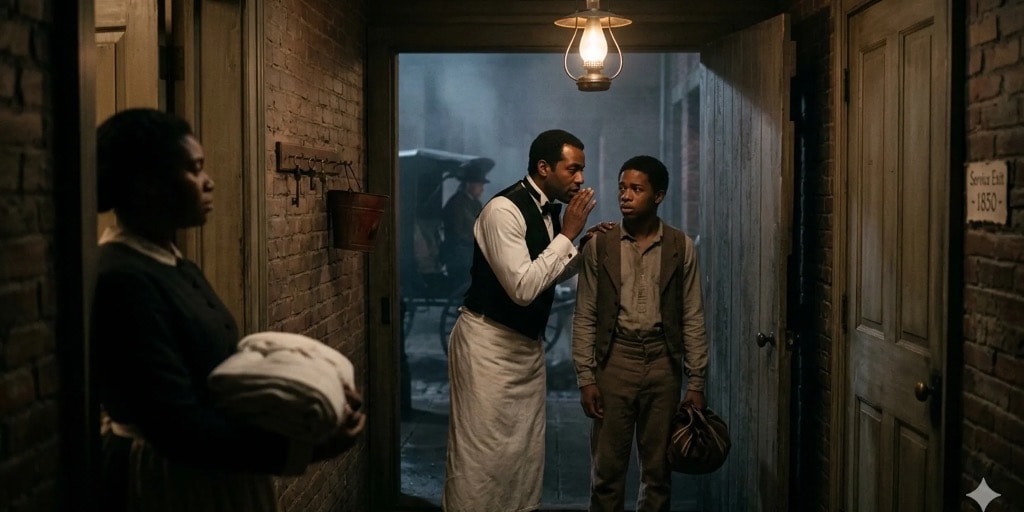
The Legacy: The history of Arthursville shatters the historical myth that early Black Americans were passive observers in urban history. The residents of this Lower Hill District enclave built a prosperous, autonomous community under the shadow of oppression. Their legacy proves that long before the modern Civil Rights movement, Pittsburgh's Black community had already mastered the art of economic empowerment, community defense, and institutional brilliance.
This profile is part of Pittsburgh's Pathway to 250™: Black Excellence & Legacy
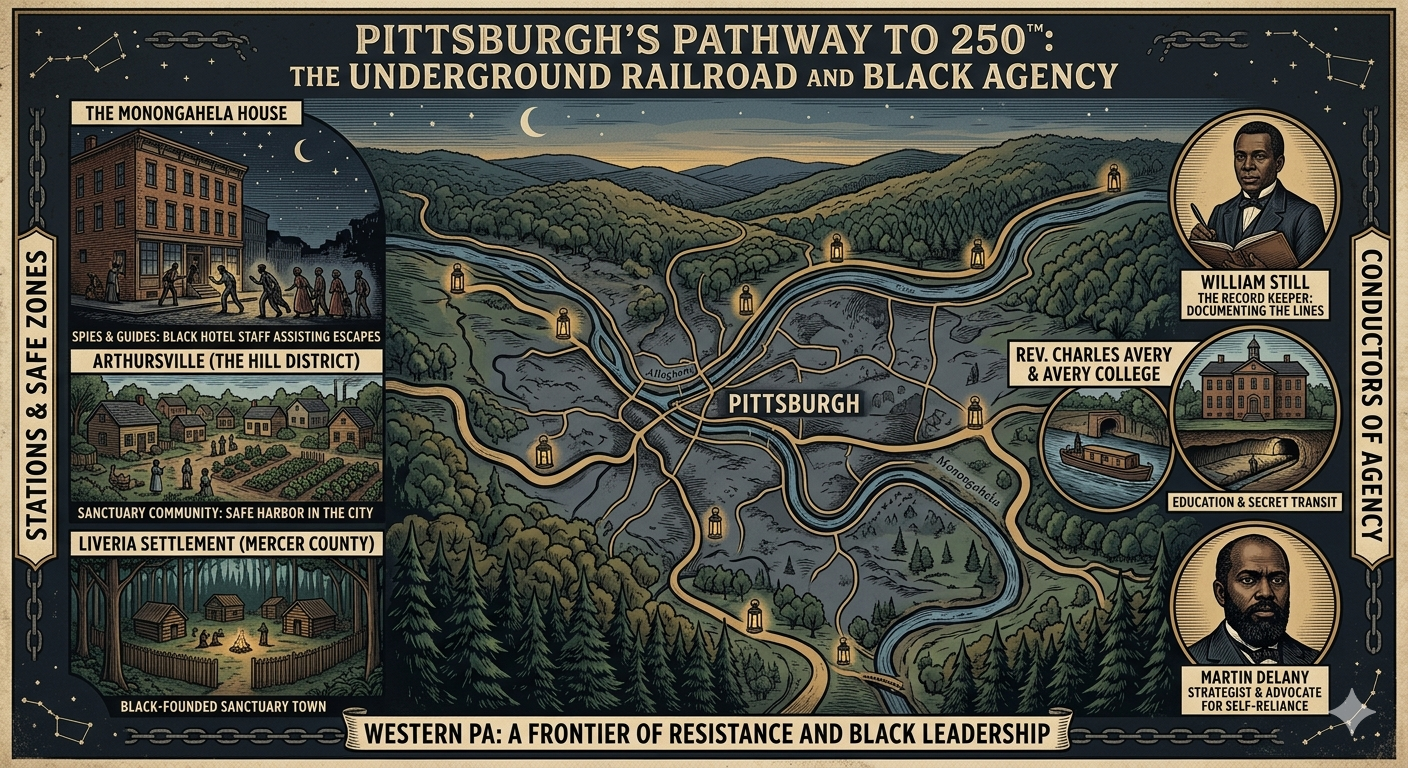
In the mid-1800s, the Monongahela House — located at Smithfield and Water Streets in downtown Pittsburgh — was the premier hotel of the American West. It hosted U.S. Presidents, international royalty, and wealthy Southern plantation owners who traveled north via the riverboat highways. But unknown to the slaveholders who frequented its lavish dining rooms, the Monongahela House was also one of the most highly effective, radical operational hubs of the Underground Railroad.
The engine of this secret network was the hotel's workforce. The Monongahela House employed an extensive staff of nearly 300 free African Americans, working as waiters, cooks, bellhops, barbers, and chambermaids. Led by prominent local Black leaders and abolitionists who intentionally embedded themselves in the hospitality industry, this workforce formed a highly organized, clandestine intelligence ring.
Their strategy was brilliant in its simplicity and daring in its execution. Because they moved invisibly through the hotel corridors, Black staff members intercepted critical pieces of information — identifying which plantation owners had brought enslaved body servants or nannies with them onto free Pennsylvania soil, and noting where those enslaved individuals were being housed.
While delivering linens or serving meals, staff members would quietly make contact with the enslaved individual, informing them that under Pennsylvania law, they could claim their immediate freedom, and that an escape network was ready to protect them.
Under the cover of night, bellhops and carriage drivers would guide freedom seekers out of the hotel's side exits, through secret service corridors, and directly into waiting carriages.
From the hotel, escapees were rushed to nearby sanctuaries like Arthursville in the Lower Hill District or onto boats managed by Black stewards on the Monongahela and Allegheny rivers.
When Southern guests discovered their "property" was missing and raised the alarm, the hotel staff practiced absolute, collective silence. If bounty hunters or federal marshals attempted to search the premises, the tight-knit network of Black workers would use legal delays, intentional misdirection, and — if necessary — physical intervention to ensure the freedom seekers were long gone.
By weaponizing their proximity to wealth and power, the workers of the Monongahela House completely flipped the paradigm of the service industry. They proved that true excellence and resistance didn't always happen in the open — sometimes, it was forged in the quiet corridors of espionage, right under the noses of those who sought to deny them their humanity.
The grand rebuild of the Monongahela House opens, establishing it as a premier luxury hub and drawing wealthy travelers from slave-holding states.
Black staff members successfully coordinate the high-profile escape of several enslaved individuals brought to the hotel by visiting cotton planters.
Following the passage of the federal Fugitive Slave Act, the hotel network escalates its security, utilizing secret codes and trusted local safe houses to bypass increased marshal patrols.
President-elect Abraham Lincoln stays at the Monongahela House on his way to his inauguration, addressing a crowd from the balcony while protected by an elite detail of the city's Black civic leaders and hotel staff.
The Legacy: The espionage ring at the Monongahela House stands as a masterful testament to the sophistication of Black resistance in early Pittsburgh. These hospitality workers were not passive bystanders; they were highly skilled, courageous strategists who used their economic positioning to run a critical frontline rescue operation.
This profile is part of Pittsburgh's Pathway to 250™: Black Excellence & Legacy

Most People Leave Gettysburg Without Hearing the Full Story.
The Gettysburg Black History Trail tells the stories of the African American men, women, and children who lived, fought, and shaped one of America’s most historic towns — stories that most visitors never hear.
From the United States Colored Troops who fought at the Battle of Gettysburg, to the Black residents who built community in Adams County before and after the Civil War — this trail puts their legacy front and center. Add it to your Pennsylvania Freedom Trail road trip.
Presented in partnership with Destination Gettysburg & Adams County, PA
Pittsburgh's Pathway to 250™
A multi-platform initiative by PittsburghUrbanMedia celebrating 250 years of African American impact in Western Pennsylvania. New stories every week through the end of 2026.
Read All Stories