
What Does “Black Power Under Authoritarianism” Mean for Black Pittsburgh?
Nikole Hannah-Jones, Eddie S. Glaude Jr. and Jeff Cowie join Pittsburgh conversation Thursday as Marguerite Casey Foundation announces new local grants
PITTSBURGH — Pittsburgh has a long history of Black communities organizing around questions of political power, economic opportunity, voting rights and the right to shape the future of their own neighborhoods.
This Thursday, some of the nation’s most prominent voices on race, democracy and American history will bring those questions into a Pittsburgh room.
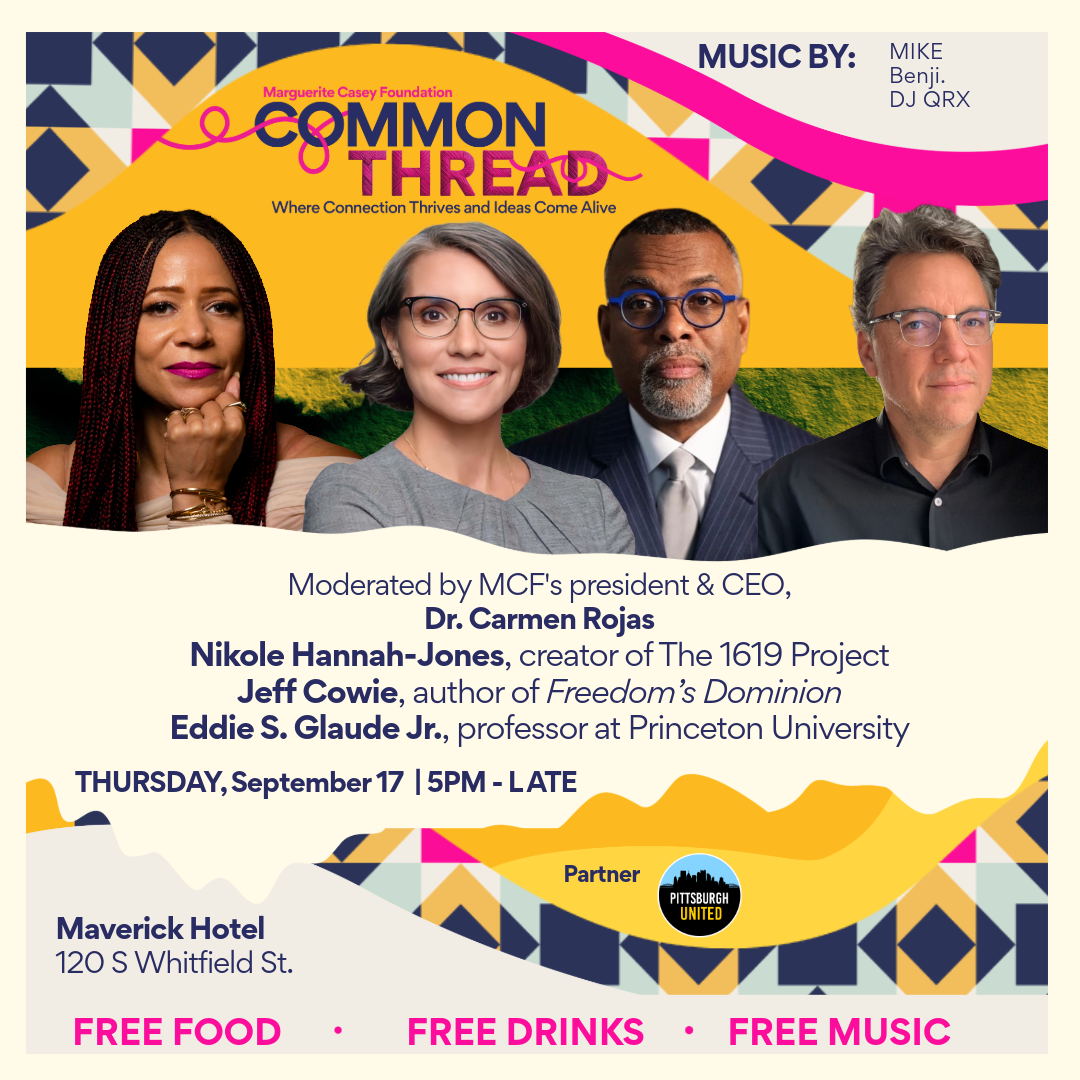
The Marguerite Casey Foundation will host “Black Power Under Authoritarianism,” the Pittsburgh installment of its Common Thread event series, on Thursday, September 17, beginning at 5 p.m. at the Maverick Hotel in East Liberty.
The free public event will feature a conversation with Nikole Hannah-Jones, creator of The 1619 Project; Eddie S. Glaude Jr., Princeton University professor and author; and Jeff Cowie, author of Freedom’s Dominion. The discussion will be moderated by Marguerite Casey Foundation President and CEO Dr. Carmen Rojas.
But for Black Pittsburgh, the title of the conversation raises a larger question:
What does Black political power mean in a city with such a deep history of Black activism — and where significant racial disparities continue to shape housing, income, education and opportunity?
Pittsburgh has its own history of fighting for power
The conversation is particularly relevant in Pittsburgh because Black political organizing is not new here.
From the city’s abolitionist history to the Black newspapers, churches, civic organizations and neighborhood institutions that developed throughout the 20th century, Black Pittsburghers have repeatedly organized around citizenship, voting rights and economic opportunity.
The Heinz History Center documents how Pittsburgh’s Black community organized around suffrage following the Civil War, including a 1870 “Jubilee of Freedom” parade celebrating the restoration of voting rights for African Americans.
That tradition continued through the 20th century.
Pittsburgh produced influential political figures including Homer S. Brown and K. Leroy Irvis, while community organizers, churches and civil rights organizations pushed against discrimination in employment, housing, education and public services.
The city also became home to some nationally significant examples of community-led institution building.
In the Hill District, for example, Freedom House Ambulance Service emerged in the late 1960s to address the lack of adequate emergency medical care in the Black community. It became one of the nation’s pioneering community-based emergency medical services and trained predominantly African American paramedics.
These examples point to an important part of Pittsburgh’s Black history: political power has often been connected to the ability of communities to build institutions, advocate for resources and have a voice in decisions affecting everyday life.
The Pittsburgh conversation comes at a complicated moment
The issues being discussed Thursday also intersect with challenges that remain visible in Pittsburgh today.
City and regional research has documented racial disparities in housing, income, employment, education, health and other measures of opportunity. Pittsburgh’s own equity research has identified significant differences in outcomes and access to resources between Black and white residents.
Housing is one example.
A City of Pittsburgh housing analysis found that historic practices including redlining, racial steering and discriminatory lending contributed to racial disparities in homeownership and neighborhood stability.
Income is another.
City research has found significant racial and gender disparities in Pittsburgh’s income levels, including particularly low relative incomes among Black women compared with Black women in many other U.S. cities.
Those realities make the conversation about power more concrete.
For many Black Pittsburghers, political power is not simply about elections or who holds office. It can also mean who gets to influence development, who has access to economic opportunity, whose neighborhood receives investment, who has a seat at the table and whether community voices translate into decisions.
Why the words “Black Power” matter
The phrase “Black Power” carries a long and complicated history in America.
At its core, however, the term has historically been associated with Black self-determination, political participation, economic empowerment and the ability of Black communities to organize around their own interests.
Thursday’s discussion adds another phrase to it: “under authoritarianism.”
That framing invites a national conversation about what happens to democratic participation when institutions, voting rights, public resources and political power are contested.
For Pittsburgh, those questions can be viewed through a distinctly local lens.
What happens when longtime Black neighborhoods experience displacement or demographic change?
What happens when residents have limited access to wealth-building opportunities?
How does a community maintain political influence when its population changes?
And perhaps most importantly:
How does a community preserve its ability to organize, advocate and determine its future?
Those are questions that extend well beyond Thursday night’s event.
A Pittsburgh gathering with a national conversation — and local investment
The Marguerite Casey Foundation says the Common Thread series is designed to bring together authors, scholars, journalists, community members, organizers, musicians and artists to discuss issues affecting communities and explore collective action.
Pittsburgh is the sixth city in the series, following events in Greensboro, Kansas City, Milwaukee, Grand Rapids and Portland, Maine.
The Pittsburgh event will also have a significant local component.
The evening will include performances by MIKE and Benji., an after-party with DJ QRX, free food and community organization tables.
Participating local organizations include Pittsburgh United, 1Hood, One PA, Casa San Jose and the Alliance for Police Accountability.
Most significantly for Pittsburgh’s nonprofit and community landscape, the foundation says it will announce new grants for a number of local organizations during the event.
That makes Thursday’s gathering more than a panel discussion.
It is also an opportunity to see which Pittsburgh organizations will receive new philanthropic support — and what those investments could mean for communities across the region.
The conversation belongs to Pittsburgh, too
National voices such as Hannah-Jones, Glaude and Cowie bring historical and national perspectives to the discussion.
But Pittsburgh has its own experts, organizers, institutions and residents who have been wrestling with these questions for generations.
From the Hill District to Homewood, East Liberty, the North Side and communities throughout the region, Black Pittsburgh has a history of building organizations, demanding representation and challenging systems that have limited opportunity.
Thursday’s gathering provides another opportunity to ask where that history goes next.
Who has power? Who gets heard? Who controls resources? And what does it take for Black communities to maintain a meaningful voice in the decisions that shape their future?
Those questions make “Black Power Under Authoritarianism” a conversation worth watching — and one that has particular resonance in Pittsburgh.
- What: MCF Common Thread: Black Power Under Authoritarianism
- When: Thursday, September 17, 2026 — Doors open at 5 p.m.
- Where: Maverick Hotel, 120 S. Whitfield St., Pittsburgh, PA 15206
- Admission: Free; registration required
- Nikole Hannah-Jones, creator of The 1619 Project
- Eddie S. Glaude Jr., Princeton University professor and author
- Jeff Cowie, author of Freedom’s Dominion
Dr. Carmen Rojas, President and CEO, Marguerite Casey Foundation
MIKE and Benji. • After-party with DJ QRX • Free food
Pittsburgh United • 1Hood • One PA • Casa San Jose • Alliance for Police Accountability